What is a machinery loan?
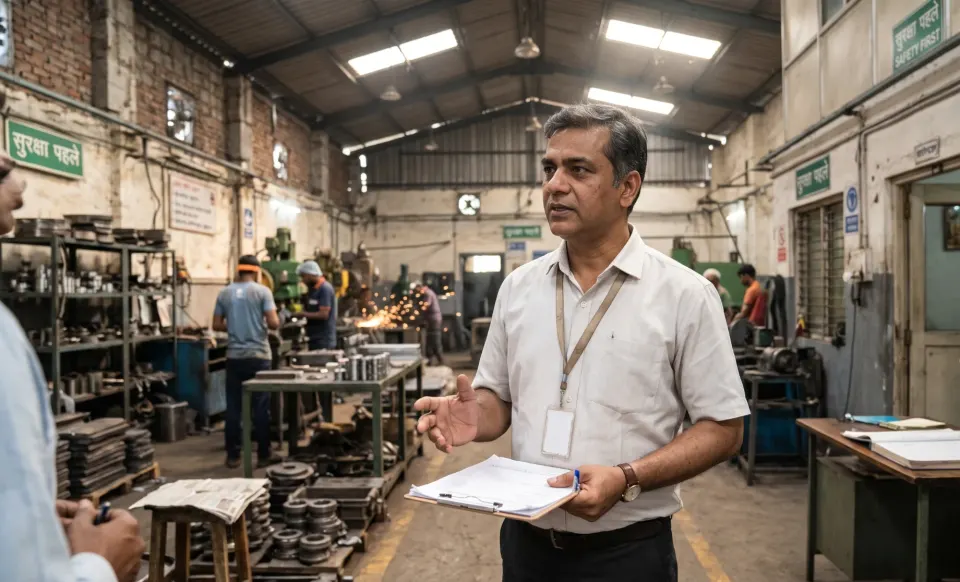
A machinery loan is a business loan used to buy equipment, such as a production machine, a CNC or packaging line, medical equipment or a commercial kitchen. The lender usually pays the supplier directly against a quotation or invoice, and the machine itself often serves as security until the loan is repaid. You put in part of the cost yourself. It suits a business that can show the purchase will earn enough, through more output or lower costs, to cover the EMI.
How does a machinery loan work?
You choose the machine and get a formal quotation from the supplier. The lender assesses your business and the quotation, sanctions the loan, and pays its share to the supplier, usually after you have paid your own share. Once it is delivered and installed, the lender records its charge on it, which is removed when the loan is repaid. Most lenders also ask you to insure it for as long as the loan runs.
Machinery loan or another route?
| Machinery term loan | Pays for a specific machine, usually secured on that machine, repaid in fixed EMIs |
|---|---|
| Unsecured business loan | No security, so quicker for smaller needs, but often costlier and more dependent on your financials |
| Loan against property | Can fund larger purchases over a longer tenure, but your property is at risk if repayments are missed |
| Government schemes | Mudra and PMEGP can fund equipment for small and new units, and CGTMSE can help a bank lend without collateral |
| The test | Match the tenure to how long the machine will earn, and compare total cost, not just the EMI |
Who is eligible for a machinery loan?
Lenders look at how long the business has been running, its turnover and profit in recent returns, the pattern of credits and balances in its bank statements, GST filings, existing loans, and the credit records of the business and its owners. They also look at the purchase itself: whether it fits your business, whether the supplier is established, and whether the added output or savings can cover the EMI. A newer business may need a stronger own contribution, extra security or a scheme.
What documents do you need for a machinery loan?
| Proprietors | KYC and PAN, business registration such as Udyam or GST, business bank statements, recent income tax returns with financial statements |
|---|---|
| Partnerships and companies | The above for the firm or company, plus the partnership deed or company documents and KYC of partners or directors |
| Machine details | The supplier's formal quotation or proforma invoice, with make, model and specifications |
| For a new unit | A project report showing how the machine will be used and how the loan will be repaid |
How much can you borrow?
There is no fixed figure. The lender funds part of the cost and expects you to pay the rest, and the amount also depends on how much repayment your business can carry after its existing EMIs. A larger own contribution and strong cash flow make a bigger loan easier. Lenders' limits differ by type of equipment and by business.
How does Atlanta Group help with a machinery loan?
- Listening to your requirementWe start with the machine you need, why, its cost, and how your business is doing.
- Understanding your business's financial profileWe look at your returns, bank statements, GST filings and existing loans, as the lender will.
- Choosing the right kind of financeA machinery term loan, an unsecured loan, a secured loan or a scheme: we match the route to the purchase and your business.
- Shortlisting lenders and comparing optionsWhere available, we identify two to three suitable options from our associated banks and NBFCs and compare their rate, tenure, own-share requirement, charges and total cost.
- Application planning and documentsWe check the quotation, your financials and, for a new unit, the project report before submission.
- Submission and lender coordinationWe submit the application and coordinate the lender's questions and any visit.
- Lender assessmentThe lender checks your business, the supplier and the quotation. Atlanta Group facilitates the application and provides guidance; the final decision rests with the lending institution.
- Sanction and offer evaluationWe go through the sanction letter and Key Fact Statement with you, including security, insurance and prepayment terms.
- Payment to the supplierWe follow up until the lender pays the supplier and the equipment is delivered.
- Support after disbursementYour dedicated relationship manager stays your point of contact.
How long does a machinery loan take?
It depends on the lender, how complete your documents are and how quickly the supplier provides a proper quotation. Secured loans and new units take longer than an established business buying standard equipment. The timeline below is an indicative planning guide, not a guarantee. The lender decides, and we cannot promise a date.
Indicative timeline
| Initial discussion | Same day |
|---|---|
| Document collection and preliminary analysis | About 1–2 working days after we receive your documents |
| Lender shortlisting and application preparation | About 1–3 working days, depending on document readiness and the quotation |
| Lender assessment and verification | Around 3–10 working days or more |
| Sanction and acceptance | Depends on the lender |
| Payment to the supplier | Depends on the lender's conditions, your own share and completion of formalities |
What decides the rate and the cost?
The lender sets the rate from your business's record, the type of equipment, the security, the tenure and its own policy. Look beyond the rate at the processing fee, documentation charges, the cost of insurance, and any charge for closing the loan early. RBI directions now limit pre-payment charges on many floating-rate loans to individuals and small businesses, depending on the lender and the loan. Ask for the Key Fact Statement and compare total cost.
How is the EMI calculated on a machinery loan?
Your EMI depends on three things: the amount, the interest rate and the tenure. The standard formula is EMI = P x r x (1+r)^n divided by ((1+r)^n - 1), where P is the loan amount, r is the monthly interest rate and n is the number of monthly instalments. Keep the tenure within the machine's useful working life, so you are not still paying for equipment you have replaced. Our EMI Calculator helps you try different tenures.
Tax on a machinery loan
For a business, the interest on a machinery loan is generally a business expense, and the equipment itself is usually written off over its life through depreciation, both of which reduce taxable profit. How this applies depends on your business and tax regime, so ask your chartered accountant.
Why do machinery loan applications get rejected?
Weak or irregular financials, a business too new to show income, a credit record with recent defaults, too many existing EMIs, a quotation from a supplier the lender cannot verify, a machine that does not fit the business, or no own contribution. Many of these can be fixed before you apply, which is why we look at the quotation and the numbers first.
What mistakes should you avoid?
Placing an order before checking what the business can repay. Taking a tenure longer than the machine's working life. Using a quotation without full specifications. Forgetting installation, insurance and running costs. Pledging your home for equipment when the machine itself could be the security. Applying to several lenders at once.
What our customers say
“Our business needed new machinery to improve production capacity. Arranging the finance was an important part of the expansion plan. Atlanta Group helped us understand the machinery loan process and coordinate the application. The loan was sanctioned, and we are thankful for their support in helping us move forward.”
Not sure where you stand?
Tell us your income, existing EMIs and what you need. We will check your profile free of charge and explain which options may be worth exploring before you apply anywhere.
Frequently asked questions
Can I get a machinery loan without collateral?
Often, yes, because the machine itself usually serves as security, and some lenders offer unsecured equipment loans to businesses with strong financials. For eligible small businesses, the CGTMSE guarantee can also help a bank lend without other collateral. Our Government Loan Schemes page explains the schemes.
Do you arrange finance for second-hand machinery?
No. We arrange finance for new machinery only. Some lenders do finance used machines after a valuation, usually on different terms, and you can approach them directly.
Can a new business get a machinery loan?
It is harder, because lenders like to see income history. A clear project report, a larger own contribution, a co-applicant or security, or a scheme for new units such as PMEGP or Mudra can make it possible.
How much do I need to pay myself?
Lenders usually fund part of the machine's cost and ask you to pay the rest, plus installation and insurance. The share depends on the lender, the equipment and your business. Plan for it before you place the order.
Which bank is best for a machinery loan?
There is no single best lender. Banks, NBFCs and specialist equipment financiers favour different machines, industries and business sizes. Comparing two or three Key Fact Statements for your purchase tells you more than any ranking.
Can I prepay a machinery loan?
Often, yes, but the terms depend on the lender and the loan, so check your sanction letter for any charge before you prepay.
Do I need to insure the machine?
Most lenders ask you to insure the machine for as long as the loan runs, with the lender named on the policy, because it is their security. Check what cover is required and compare quotes; the lender's suggested insurer is not your only choice unless the agreement says so.
Is Atlanta Group a lender?
No. Atlanta Group is a financial solutions and loan facilitation company, in business since 2010. Loans are provided by our associated banks, NBFCs and private finance providers, who decide on eligibility, approval, rates, fees and terms. We help you understand your options and guide your documents and application. Approval is never guaranteed.
Related options
Written by the Atlanta Group team, which has helped businesses explore loan options since 2010. Last updated 3 November 2026. We do not quote interest rates or loan amounts here because lender terms and RBI rules change. Confirm current terms, fees and eligibility with the lender before you decide.